How a bridge works and how an implant works, what each means for the neighbouring teeth and the bone, when a bridge is the right choice and roughly what each option costs.
What is a dental bridge?
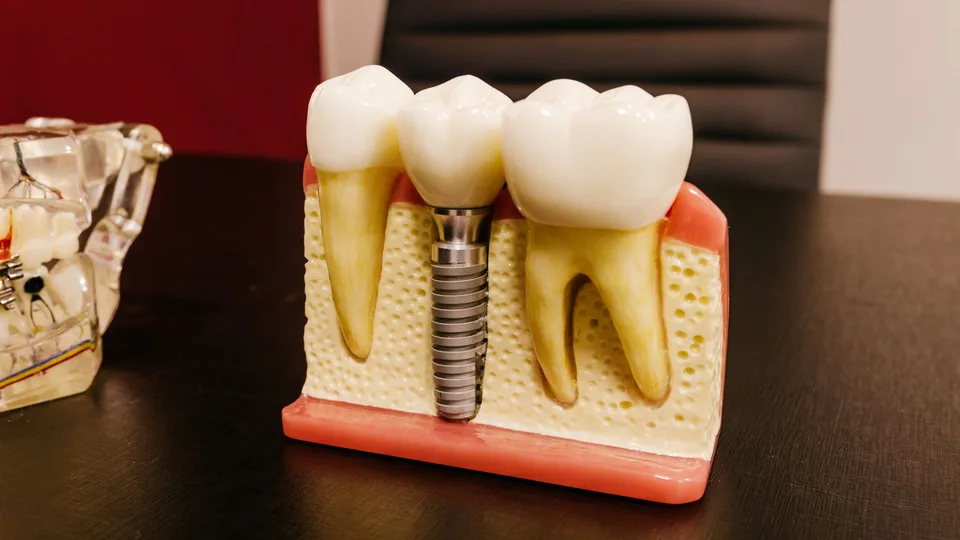
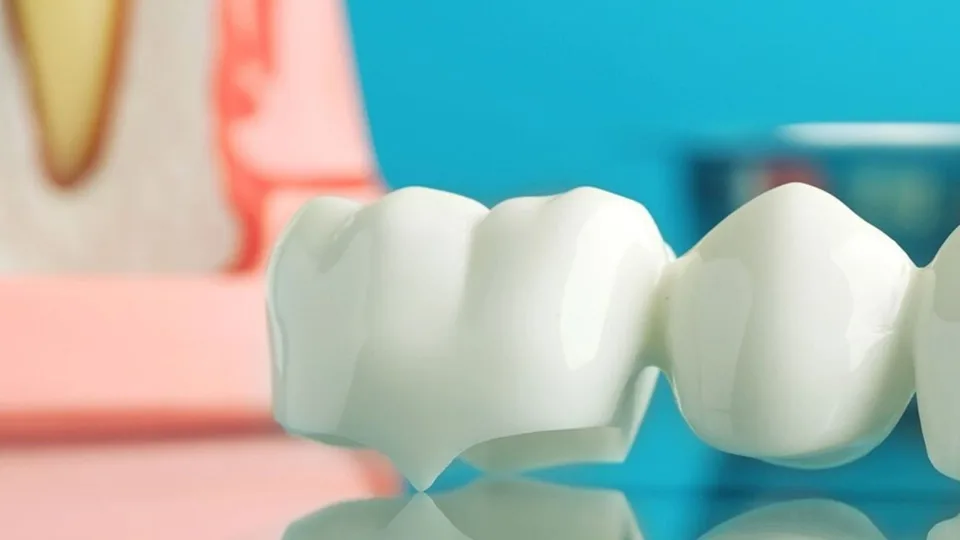
If you're missing a tooth, the question “dental bridge or implant?” usually comes up at the first consultation. A bridge is a single-piece restoration made of several crowns joined together. The teeth on either side of the gap are filed down and become supports, and the crowns at the ends of the bridge are cemented onto them. Between the supports, the missing tooth is replaced by a false tooth that rests lightly on the gum and has no root. For a single missing tooth, a bridge usually has three units: two supporting teeth and the false tooth.
What is a dental implant?
An implant is a small titanium screw placed in the bone where the lost root used to be. After about 3 months, during which the bone bonds with it, an abutment and a crown are fixed onto the implant. The implant replaces the whole tooth, from root to crown, and doesn't need support from the neighbouring teeth.
Dental bridge vs implant, point by point
- The neighbouring teeth. A bridge means filing down two teeth, even if they are healthy, and it also loads them with the chewing force of the missing tooth. An implant leaves them untouched.
- The bone. Under the false tooth, the bone no longer receives the pressure of chewing and keeps slowly shrinking; at the front of the mouth, a small gap can appear under the bridge over time. An implant transmits the force into the bone and helps to preserve it.
- Hygiene. You can't pass ordinary floss between the units of a bridge: you clean under the false tooth with special floss, interdental brushes or a water flosser. An implant is cleaned like a natural tooth, but it needs the same discipline, because the gum around it can become inflamed too.
- How long they last. A well-made bridge lasts 10 to 15 years on average. An implant can stay for life, and the crown on it is replaced after 10 to 15 years on average.
- Visits and time. A bridge is made in two or three visits, over one to three weeks, with no surgery. An implant needs a minor procedure under local anaesthetic, about 3 months of healing into the bone and then two visits for the crown.
The disadvantages of a dental bridge
The main disadvantage is that healthy tissue is sacrificed: filing down is irreversible, and a living tooth that has been prepared may sometimes need root canal treatment in the years that follow. The supporting teeth can decay at the edge of the crowns, in an area that is hard to clean. If just one support has a problem, the whole bridge often has to be removed and remade, and sometimes the new bridge ends up longer. On the other hand, a bridge is quick, needs no surgery and usually costs less up front.
What you should know about implants
Implants have their limits too. They need enough bone: if the bone has shrunk, bone grafting is done or, in the upper jaw, a sinus lift, which makes treatment longer and more expensive. Complete treatment takes a few months, not a few weeks. Uncontrolled diabetes, certain osteoporosis medicines, radiotherapy to the head area and heavy smoking call for caution and sometimes make an implant unsuitable. On the other hand, once it has integrated, an implant doesn't depend on other teeth and can't decay.
When a bridge is the better choice
- the neighbouring teeth already have large fillings or old crowns and need new crowns anyway;
- there isn't enough bone in the area, and bone grafting or a sinus lift isn't possible or you don't want it;
- your health makes surgery risky;
- you need a fixed solution within a few weeks, not a few months;
- your budget is limited: a porcelain-fused-to-metal bridge costs less than a complete implant.
Conversely, when the neighbouring teeth are healthy and the bone allows it, an implant is usually the option that preserves more of your own teeth.
Dental bridge or implant: what each costs
A bridge is usually priced per unit: each of its teeth, whether a support or the false tooth, costs the same as a crown in the chosen material, so crown prices are a good guide.
| Option | Calculation | Indicative price |
|---|---|---|
| Porcelain-fused-to-metal bridge, 3 units | 3 × 1,050 lei | 3,150 lei |
| Ceramic bridge on a zirconia framework, 3 units | 3 × 1,850 lei | 5,550 lei |
| Implant (Israel, Korea), abutment and porcelain-fused-to-metal crown | 2,250 + 600 + 1,450 lei | 4,300 lei |
| Implant (Germany, Switzerland, Italy), abutment and porcelain-fused-to-metal crown | 3,400 + 600 + 1,450 lei | 5,450 lei |
| Internal / external sinus lift, if needed | added to the implant | 1,500 / 2,700 lei |
So a three-unit dental bridge costs roughly 3,150 lei in porcelain-fused-to-metal and 5,550 lei in ceramic on zirconia. A complete implant costs roughly 4,300 lei or 5,450 lei, depending on the system chosen; with a zirconia-ceramic crown on the implant (1,750 lei), the total goes up by 300 lei. A fair comparison is between equivalent options, for example a metal-free bridge and an implant with a metal-free crown. With a bridge, root canal treatment of the supporting teeth may be added; with an implant, bone grafting or a sinus lift. You receive the exact price for your situation in your written plan, after the consultation.
Dental bridge or implant: how we decide
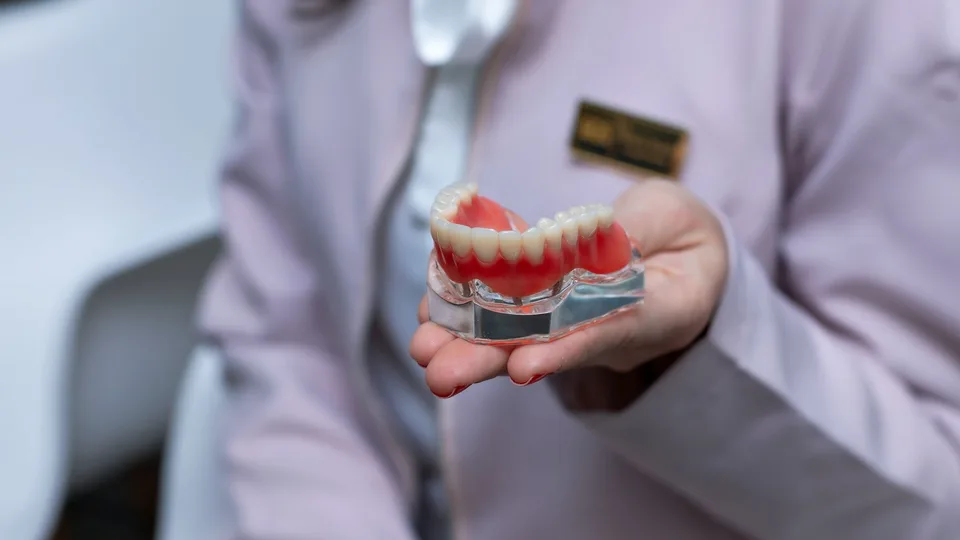
At the consultation we look at the neighbouring teeth, the gum, your bite and the amount of bone, on an X-ray or, when needed, a CT scan. We tell you openly what we recommend and why, including when a bridge is the better fit. If you haven't decided yet, a Kemeny denture, small and removable, can fill the gap temporarily. What matters is not to leave the gap for years: the neighbouring teeth tilt, the tooth in the opposite jaw drifts towards the gap and the bone shrinks, which makes any solution more complicated later on.
Frequently asked questions
Which is better, a dental bridge or an implant?
It depends on the neighbouring teeth, the bone and your general health. When the neighbouring teeth are healthy and the bone allows it, an implant spares them; when they need crowns anyway, a bridge is a very good choice.
How long does a dental bridge last?
On average 10 to 15 years, sometimes longer, if the supporting teeth stay healthy. The most common reason for redoing a bridge is decay at the edge of a supporting tooth, which is why cleaning under the bridge every day matters.
Does an implant hurt more than a bridge?
Both are done under local anaesthetic. After an implant the area may be tender for a day or two, and after the supporting teeth have been prepared, they may be sensitive to cold for a few days.
How much does a three-tooth dental bridge cost?
Roughly 3,150 lei in porcelain-fused-to-metal and 5,550 lei in ceramic on a zirconia framework, calculated per unit. Any treatment needed on the supporting teeth is added.