The signs that call for an orthodontic check-up, why treatment started at the right time guides jaw growth, what each brace or appliance for children does, what it costs and how you can help at home.
Crooked teeth in children: what's normal and what isn't
Parents usually notice crooked teeth in children between the ages of 6 and 8, when the permanent teeth start to come through. Not every irregularity is a problem. Gaps between baby teeth are a good sign: permanent teeth are bigger and need room. Slight crowding of the lower front teeth often improves as the arch grows, and a gap between the upper front teeth at 8 or 9 often closes when the canines come through. Other problems don't go away on their own and can get worse as the child grows.
When to see an orthodontist
The first orthodontic check-up is recommended at around the age of 6 or 7, even if the teeth look fine; if you notice a problem earlier, for example the lower teeth closing in front of the upper ones, don't wait until then. The first step is the initial orthodontic consultation, which costs 250 lei: the orthodontist examines the teeth, jaws and bite and watches how your child breathes and swallows. Often the answer is “no brace needed for now”, and the orthodontist tells you when to come back.
Signs that call for an orthodontic check-up
- crowded, overlapping or rotated teeth;
- a crossbite: upper teeth that close behind the lower ones;
- an open bite: when the teeth are closed together, the front ones don't touch;
- upper teeth that stick out a lot;
- a lower jaw that sits in front of the upper jaw;
- baby teeth lost too early;
- mouth breathing, during the day or in sleep;
- thumb sucking or a dummy after the age of about 3;
- speech problems, for example saying “s” with the tongue between the teeth.
Why starting treatment at the right time matters
In children, the jawbones are still growing. Interceptive orthodontics and dentofacial orthopaedics make use of this growth and guide the development of the jaws, not just the position of the teeth. An upper jaw that is too narrow can be widened relatively easily in a child, as long as the suture in the middle of the palate hasn't closed; in an adult it is much harder. Early treatment corrects problems that would get worse, such as a crossbite, and sometimes shortens later treatment with fixed braces or avoids extractions. It isn't a guarantee: many children need both stages.
Crooked teeth from a dummy or thumb sucking
Dummies and thumb sucking are normal in babies. When the habit continues after the age of 3, the constant pressure pushes the upper teeth forward and leaves a gap between the front teeth (an open bite); sometimes the upper jaw narrows as well. If the habit stops early, crooked teeth caused by a dummy often correct themselves; if it carries on after the permanent teeth have come through, treatment is needed. Breaking the habit takes patience and praise, not punishment. Mouth breathing often has a cause in the nose or throat (for example enlarged adenoids), which an ENT specialist checks.
Appliances for crooked teeth in children: what each one does
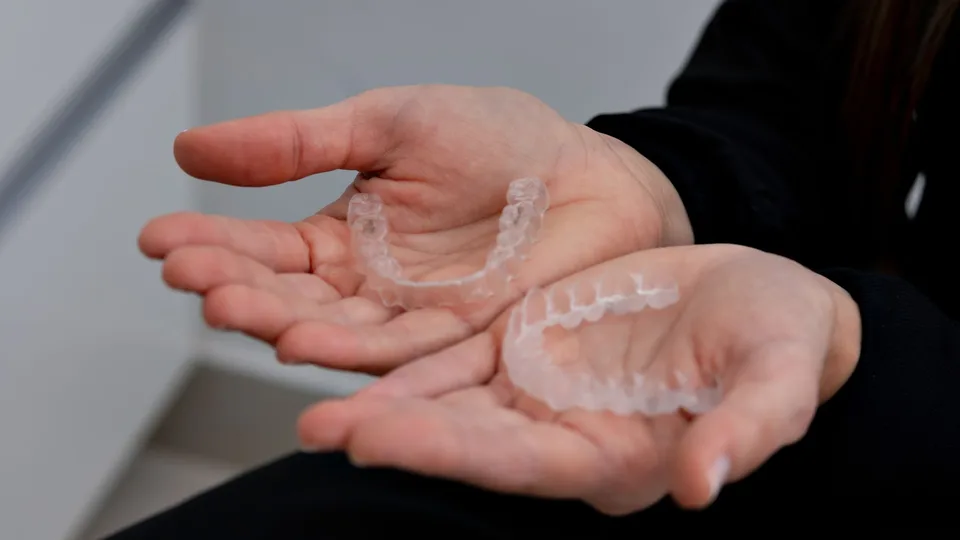
- The myofunctional trainer, a soft appliance worn for an hour or two a day and during sleep, corrects the position of the tongue and lips, encourages breathing through the nose and guides the teeth as they come through.
- The removable appliance, a plate with fine wires and a screw, is taken out for meals and brushing; it widens the arch slightly or moves a few teeth.
- The Twin-block holds the lower jaw slightly forward during the growth period, when it has fallen behind and the upper teeth seem to stick out.
- The palatal expander, fixed to the upper molars, widens an upper jaw that is too narrow using a screw turned at home, following the schedule you are given; the small gap that temporarily appears between the front teeth shows that it is working.
- The Delaire face mask, worn at home and during sleep and attached with elastics to an appliance in the mouth, pulls the upper jaw forward when the lower jaw seems too far forward; it works best before the age of 10.
- The quad-helix, a springy wire fixed to the upper molars, slowly widens the arch and corrects a crossbite.
- The lip bumper keeps the lower lip away from the teeth in children who suck it and makes room for crowded lower teeth.
- The fixed space maintainer holds the space of a baby tooth lost too early until the permanent tooth comes through.
Fixed braces, metal, ceramic or sapphire, usually come at around the age of 11 to 13, once most of the permanent teeth have come through.
How much do braces for kids cost?
Prices are per appliance; which appliance suits your child, how many check-ups are needed and the total cost are set out in your written plan, after the consultation.
| Appliance or stage | Price |
|---|---|
| Initial orthodontic consultation | 250 lei |
| Lip bumper | 300 lei |
| Quad-helix | 350 lei |
| Fixed space maintainer | 400 lei |
| Delaire face mask | 500 lei |
| Myofunctional trainer | 800 lei |
| Removable appliance | 900 lei |
| Twin-block | 1,100 lei |
| Simple palatal expander | 1,200 lei |
| Fixed braces, metal / ceramic / sapphire | 2,500 / 3,000 / 3,500 lei |
Some appliances are used together: the Delaire face mask is usually attached to a palatal expander, so, roughly, 1,200 + 500 = 1,700 lei, not including check-ups.
How you can help at home
- Wearing time and check-ups. A removable appliance only works while it is in the mouth: stick to the hours prescribed, keep it in its case, not in a napkin, and come to check-ups at the agreed intervals.
- Hygiene. Teeth are brushed before the appliance goes back in; the appliance is cleaned with a toothbrush and cold or lukewarm water, never hot. With fixed braces, avoid hard and sticky foods.
- The first few days. Pressure on the teeth and slightly different speech usually pass within a few days. If a wire is rubbing the cheek or the appliance has broken, call us.
- Motivation. Praise rather than scold: a child who understands why they are wearing the appliance cooperates better.
Frequently asked questions
Do crooked teeth in children straighten out on their own?
Some small irregularities, such as slight crowding of the lower front teeth, improve as the arch grows. A crossbite, a lower jaw that sits forward or a lack of space, however, don't correct themselves.
When should we see an orthodontist for the first time?
At around the age of 6 or 7, even if you can't see any problem. If you notice a crossbite or a lower jaw that sits forward earlier, book the check-up then.
How much do braces for kids cost?
The appliances used during the growth period cost between 300 and 1,200 lei at our clinic, depending on the type, and fixed braces start at 2,500 lei. The cost of the whole treatment depends on the case and the number of check-ups.
How many hours a day does my child need to wear a removable appliance?
As long as the orthodontist advises: usually all night and a few hours during the day, and some appliances almost all the time. An appliance left in its case doesn't work, which is why wearing it consistently matters most.