Why teeth react to cold or sweet things, what sensitivity is normal after a scale and polish, a filling or whitening, when it becomes a warning sign and what helps, at home and at the clinic.
What is tooth sensitivity?
If you feel a brief “twinge” in a tooth when you drink something cold, breathe in cold air or eat something sweet, you most likely have sensitive teeth. The pain is sharp, but it passes within a few seconds, as soon as the trigger is gone.
Enamel covers and insulates the crown of the tooth. Underneath it lies the dentine, which is crossed by very fine tubules leading to the nerve. When the dentine is left exposed, because the enamel has worn thin or the gum has receded, cold and sweet things set the fluid inside these tubules moving, and the nerve reacts instantly.
The most common causes
- Receding gums. The root has no enamel, only a very thin covering that wears away easily. When the gum recedes, because of gum disease, brushing too hard or age, the root is left exposed.
- Erosion. Acids from juices, fizzy drinks, wine and citrus fruit, or from acid reflux, gradually wear the enamel thin.
- Brushing too hard, with a hard toothbrush and side-to-side strokes, which wears the tooth away next to the gum.
- Teeth grinding (bruxism), which wears down the enamel and can crack teeth.
- Cavities, cracks and old fillings, which usually cause sensitivity in a single tooth.
- Whitening, which temporarily makes the enamel more permeable.
Teeth sensitive to cold, heat or sweet things
Brief sensitivity to cold in several teeth usually comes from exposed tooth necks at the gumline or from eroded enamel. If a single tooth is sensitive to sweet things, the cause is often a cavity or a filling that no longer seals properly. Sensitivity to heat that lingers is more often a sign of an inflamed nerve and should be checked quickly.
Normal sensitivity that goes away on its own
Sometimes sensitivity is only temporary:
- Sensitivity after a scale and polish. If old tartar was covering the neck of the tooth, your teeth may react to cold for a few days, less often for one or two weeks.
- Sensitivity after a filling. After a large or deep filling, the tooth may be sensitive to cold or to biting for a few days, sometimes for two or three weeks. If the tooth “touches first” when you close your mouth, the filling is slightly too high and can be adjusted in a few minutes.
- Sensitivity after whitening. It usually lasts a day or two.
What matters is that the sensitivity eases from one day to the next. If it is still the same after a few weeks, or gets worse, call us.
When it's a warning sign
Book a check-up if:
- the pain lasts for tens of seconds or for minutes after the trigger has gone;
- the tooth hurts on its own or wakes you up at night;
- it hurts when you bite on a particular tooth;
- one tooth is becoming more and more sensitive;
- a swelling appears on the gum next to a tooth.
These signs usually point to a deep cavity, a crack or an inflamed nerve. A swelling that keeps growing, with a fever or difficulty swallowing or breathing, is a medical emergency: call 112.
What you can do at home
- A soft toothbrush, without pressing. Hold the brush at 45 degrees to the gum and use short strokes from the gum towards the tip of the tooth.
- A toothpaste for sensitive teeth, every day. The effect builds up gradually, usually over two to four weeks, and lasts as long as you keep using it. After brushing, spit the toothpaste out without rinsing with water.
- No abrasive toothpastes, such as some whitening or charcoal toothpastes.
- Fewer acidic drinks. Juices, fizzy drinks, wine or water with lemon do less harm with meals than sipped throughout the day.
- Don't brush straight after acidic food or drinks. Softened enamel wears away easily, so wait at least 30 minutes, ideally an hour.
- Reflux or frequent heartburn should be discussed with your GP, because stomach acid erodes the teeth.
Sensitive teeth: treatment at the clinic
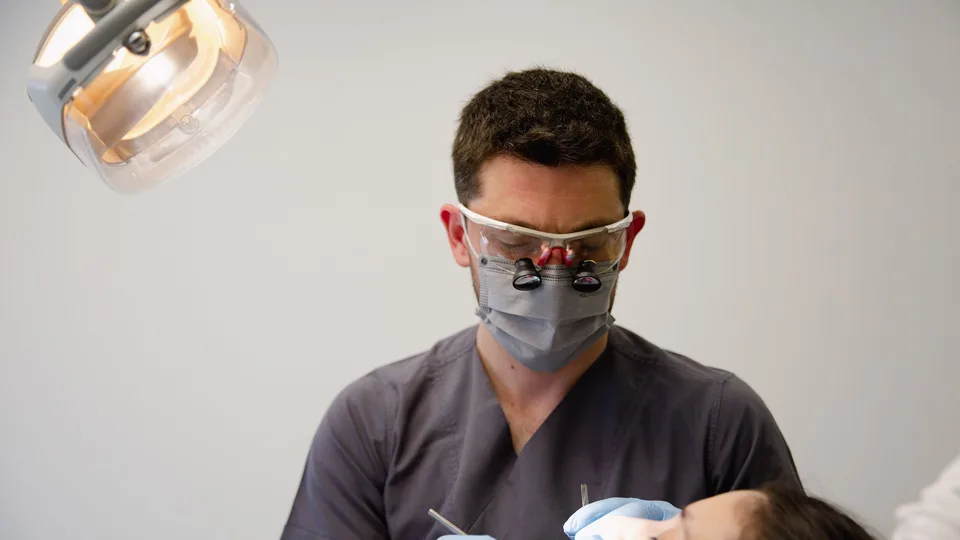
The first step is to find the cause. At the consultation (250 lei) the dentist looks for cavities, cracks and fillings that no longer seal properly, checks your gums, wear and bite, and tests your teeth with a jet of air. Then we choose the treatment:
- A desensitiser (80 lei per tooth) seals the tubules of the exposed dentine; the effect is often felt straight away.
- Fluoride treatment strengthens the enamel: applied as a topical fluoride varnish or gel (150 lei per arch), with trays (320 lei) or with the laser on each sensitive tooth (100 lei per tooth).
- A filling at the gumline uses composite to cover the notch that has formed next to the gum, from 250 lei.
- Gum recession coverage (1,500 lei per tooth) is a procedure on the gum, done under local anaesthetic, that covers the root again, in cases where this is possible.
- A night guard (300 lei per arch) protects your teeth if you grind them in your sleep.
If a cavity or an inflamed nerve is to blame, we treat the tooth first.
What it costs
| Procedure | Price |
|---|---|
| Consultation | 250 lei |
| Desensitiser application, per tooth | 80 lei |
| Topical fluoride treatment, per arch | 150 lei |
| Fluoride treatment with trays | 320 lei |
| Laser topical fluoride treatment, per tooth | 100 lei |
| Composite filling at the gumline | from 250 lei |
| Gum recession coverage, per tooth | 1,500 lei |
| Night guard for bruxism, per arch | 300 lei |
For example, a desensitiser on three teeth costs 240 lei. You receive the exact price in your written plan, after the consultation.
How to stop it coming back
Sensitivity comes back if the cause remains, so the habits above still matter after treatment. A professional cleaning every 6 months (500 lei) and a check-up catch small cavities, receding gums and wear early. If you have sensitive teeth, tell us before your cleaning, so we can adjust the intensity of the instrument.
Frequently asked questions
Does tooth sensitivity go away on its own?
Sensitivity that appears after a scale and polish, a new filling or whitening usually eases by itself. Sensitivity caused by exposed tooth necks or eroded enamel improves with the right toothpaste and treatment at the clinic, but it comes back if the cause isn't dealt with.
How long does sensitivity last after a scale and polish?
Usually a few days. If your teeth still react just as strongly after two weeks, come in for a check-up: a desensitiser or fluoride treatment usually helps quickly.
Why does a tooth hurt when I eat something sweet?
Most often it's a cavity or an old filling that no longer seals properly, less often an exposed tooth neck. It's worth having it checked now, while the problem can still be fixed with a small filling.
Which toothpaste is good for sensitive teeth?
A toothpaste for sensitive teeth, with fluoride and low abrasiveness, used twice a day. Using it consistently matters more than the brand, and at your check-up we'll tell you what suits you.