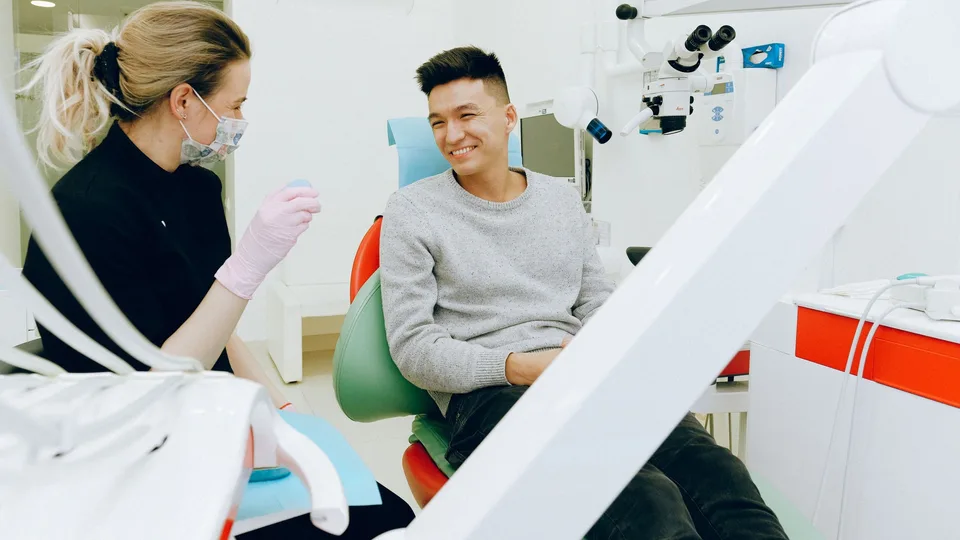
Tartar can't be removed with a toothbrush. What happens if you leave it, what a full professional cleaning involves, how often you need one and what it costs.
What tartar is and why your toothbrush can't remove it
Plaque is a soft, almost invisible film of bacteria that forms on your teeth every day. If it isn't removed, it starts to harden within 24 to 48 hours as it absorbs minerals from your saliva. That is how tartar forms: a hard, yellowish or brownish crust stuck to the tooth above the gumline and, more dangerously, below it. Once it has formed, tartar can no longer be removed with a toothbrush, however good, or with dental floss.
Tartar builds up fastest on the tongue side of the lower front teeth and on the cheek side of the upper molars, where the salivary glands open. In some people it forms very quickly, in others slowly; it depends on the make-up of your saliva, your diet and whether you smoke.
What happens if you leave it
Tartar is porous and full of bacteria. The gum next to it becomes inflamed: red, swollen and bleeding when you brush. Bad breath sets in. Over time the inflammation spreads down towards the bone and leads to gum disease, with receding gums and, eventually, loose teeth. Tartar also encourages decay at the gumline and dark stains on the teeth. All of this means long and expensive treatment, whereas a professional cleaning every 6 months costs about as much as a filling.
What a full professional cleaning includes
- Check-up. We check your gums and look for areas that bleed and for any cavities.
- Ultrasonic scaling. An instrument that vibrates very fast breaks the tartar into small pieces, and a jet of water washes it away. The intensity is adjusted to how sensitive your teeth are. It does not harm the enamel.
- Laser scaling, where needed. Below the gumline or on very sensitive teeth, we complete the cleaning with the laser, which disinfects the area at the same time.
- Air-Flow. A fine jet of air, water and a special powder removes coffee, tea and tobacco stains and cleans hard-to-reach places: the spaces between teeth, the edges of crowns, implants and the brackets of braces.
- Professional polishing. With a special paste and a rotating brush we polish the tooth surfaces, so plaque finds it harder to stick.
- Fluoride treatment, on request. A fluoride gel or varnish strengthens the enamel and reduces sensitivity.
The whole visit takes 45 to 60 minutes, doesn't hurt and needs no anaesthetic. Your teeth are visibly cleaner and lighter the very same day, and your gums settle down within a few days.
How often
- every 6 months for most adults;
- every 3 or 4 months if you have gum disease, braces or implants, if you smoke or if tartar builds up quickly;
- every 6 months for children, once all their baby teeth are through;
- before whitening, braces or an implant.
What it costs
| Procedure | Price |
|---|---|
| Adult professional cleaning (ultrasonic scaling and professional polishing) | 500 lei |
| Children's professional cleaning | 300 lei |
| Air-Flow, per arch | 150 lei |
| Laser scaling, per tooth | 200 lei |
| Fluoride treatment, per arch | 150 lei |
Scaling during pregnancy
A professional cleaning is safe during pregnancy and is actually recommended, because hormonal changes make the gums more prone to inflammation and bleeding. The best time is the second trimester. Let us know you are pregnant, so we can adjust your position in the chair and the length of the session.
After your cleaning
Your teeth may be a little sensitive to cold for a day or two, especially if the tartar was old and covered part of the root. This is normal and passes on its own; a toothpaste for sensitive teeth helps. After Air-Flow, avoid coloured food and drinks for 24 hours. And most importantly, keep it up at home: brush for two minutes twice a day and clean between your teeth every day. That way, at your next check-up, we'll have much less to clean.
How to brush properly between cleanings
- use a soft or medium toothbrush; a hard one doesn't clean any better, it just makes your gums recede;
- hold the brush at 45 degrees to the gum and use short strokes from the gum towards the tip of the tooth;
- brush every surface of every tooth, including the side facing the tongue, for at least two minutes;
- an electric toothbrush with a rotating or sonic head helps, especially if you tend to press too hard;
- in the evening, clean between your teeth with floss or interdental brushes of the right size;
- don't rinse your mouth with water straight after brushing, so the fluoride from the toothpaste stays on your teeth.
Professional cleaning if you have braces or implants
The brackets of braces and the edges of crowns on implants are places where plaque builds up easily and is hard to clean. For these patients we recommend a professional cleaning every 3 or 4 months, with Air-Flow, which reaches around brackets and under bridges without scratching the dental work. At home, interdental brushes and a water flosser are all but essential.
Common myths
“Scaling thins the enamel.” False. The instruments only remove tartar; enamel is much harder than tartar. The feeling of “thinner teeth” or bigger gaps after scaling comes from the fact that the tartar used to fill those gaps.
“If my gums bleed, I'd better not brush them.” False. Bleeding is a sign of inflammation caused by plaque left behind. Gentle but regular brushing and a professional cleaning stop it within a few days.
Frequently asked questions
Does scaling thin the enamel?
No. Ultrasonic scaling and the laser only remove tartar, and enamel is much harder. The gaps you feel after scaling used to be filled with tartar.
Why do my gums bleed during scaling?
Because the tartar has inflamed them. After the cleaning the bleeding stops within a few days; if it continues, we assess your gums.
Does scaling whiten teeth?
It removes stains and tartar, so your teeth look lighter, but it doesn't change the colour of the enamel. That's what professional whitening is for.
Does it hurt?
No. The intensity of the instrument can be adjusted, and we clean sensitive areas with the laser.