When you need a dental crown, how porcelain-fused-to-metal, zirconia and ceramic crowns differ, what suits front and back teeth, how the treatment works and what it costs.
When do you need a dental crown?
A dental crown is a restoration that covers the tooth all the way round, like a cap, and gives it back its shape, colour and strength. Your dentist will recommend one when a filling is no longer enough:
- the tooth is largely destroyed by decay or has very large fillings;
- a molar has had root canal treatment and needs protecting from cracks;
- the tooth is cracked, broken or very worn, for example from grinding;
- the shape or colour of a tooth can't be corrected with a veneer;
- the tooth is going to support a bridge or, if it is missing, is being replaced with an implant.
Types of crown at a glance
- Porcelain-fused-to-metal crown (also called metal-ceramic): a thin metal alloy framework covered with ceramic. Strong, proven over decades and affordable, especially suitable for back teeth and for bridges. The metal doesn't let light through, so it looks more opaque, and if the gum recedes, a grey line may show at the edge.
- Ceramic on a zirconia framework: a white zirconia framework covered with ceramic. Metal-free and natural-looking, suitable for front and back teeth; the ceramic on top can chip in people who grind their teeth heavily.
- Full zirconia or all-ceramic: made from a single material. Monolithic zirconia is very strong and practically doesn't chip, so it suits molars and bruxism; all-ceramic has a translucency close to that of enamel, so it suits front teeth.
- CAD-CAM ceramic: designed on a computer and milled from a block of ceramic, with very precise margins.
- Full metal: very strong, needs the least filing down and has the lowest price, but it is metal-coloured, so it is only for the teeth right at the back.
- Acrylic (temporary): only until the permanent crown is ready.
Zirconia or porcelain crown: which to choose
Many patients ask us whether to choose zirconia or porcelain teeth. “Porcelain” is the everyday name for dental ceramic, and the zirconia used in dentistry, zirconium dioxide, is also a ceramic, not a metal: white, very hard and well tolerated by the gum. In practice, you are choosing between strength and translucency:
- for front teeth, appearance matters: ceramic on zirconia, all-ceramic or CAD-CAM ceramic look natural, with no grey edges;
- for molars, strength matters: full zirconia and porcelain-fused-to-metal crowns are safe choices;
- if you grind your teeth, monolithic zirconia holds up better than layered ceramic, and a night guard protects any dental work.
How the treatment works and how many visits you need
- The consultation. The dentist checks the tooth, the gum and your bite, usually on an X-ray too. Any cavities are treated beforehand, and if the pulp is affected, root canal treatment is done first. Not every tooth that gets a crown needs its nerve removed: many living teeth carry crowns without any problems.
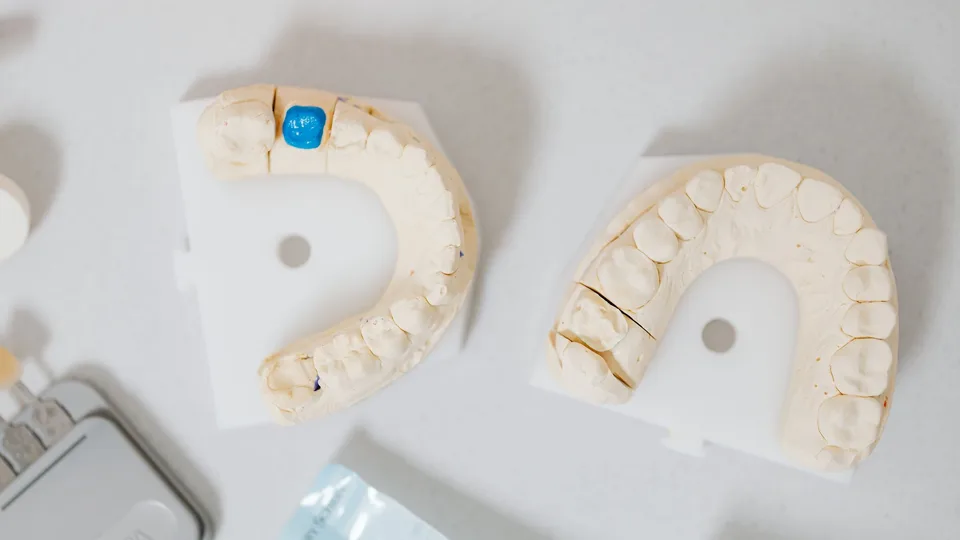
- Preparation and impression. The tooth is filed down, an impression is taken, the shade is chosen and you leave with a temporary crown.
- The try-in, after about a week: we check the shape, the colour, the contact with the neighbouring teeth and your bite.
- Permanent fitting, sometimes at the try-in itself, sometimes at a separate visit.
In total there are usually two or three visits, over one to two weeks.
Filing down the tooth and the temporary crown
To make room for the crown, the tooth is filed down evenly, usually by 0.5 to 2 mm on each side, depending on the material: a full metal crown needs the least, porcelain-fused-to-metal and layered ceramic a little more. A living tooth is worked on under local anaesthetic, so it doesn't hurt. After fitting, the tooth may be slightly sensitive to cold for a few days; if the sensitivity gets worse, call us.
The temporary crown protects the filed-down tooth, keeps the contour of the gum and stops the neighbouring teeth from moving. It is fixed with a weaker cement so that it can be taken off at the try-in, so avoid chewing gum, toffees and hard foods on that side. If the temporary crown comes off, keep it and call us; don't glue it back yourself.
Crowns on implants
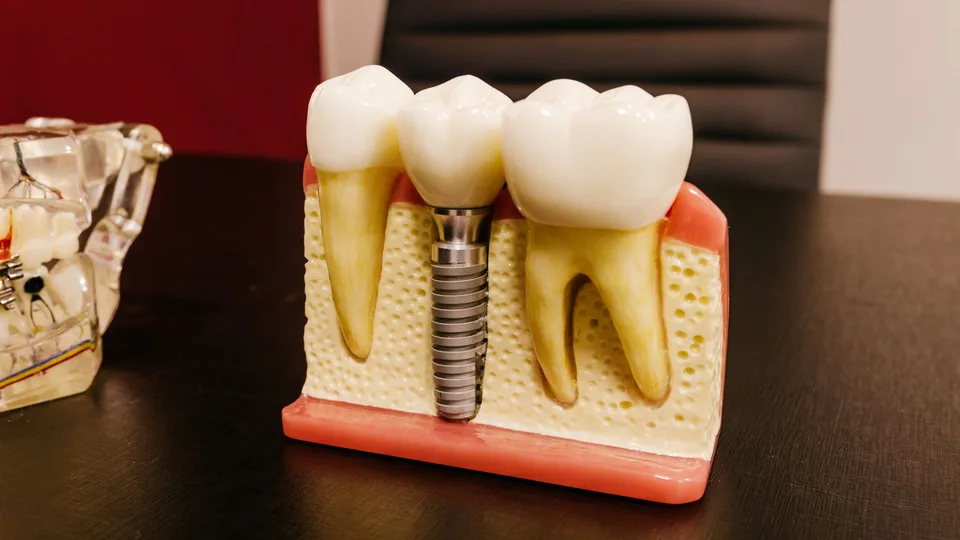
On an implant, the crown is fixed onto an abutment attached to the implant, and the neighbouring teeth are left untouched. The abutment costs 600 lei, and the implant crown 1,450 lei in the porcelain-fused-to-metal version and 1,750 lei in the zirconia-ceramic version. An implant can't decay, but the gum around it needs the same careful hygiene as a natural tooth and regular check-ups.
How much does a dental crown cost?
| Type of crown | Price |
|---|---|
| Full metal crown | 550 lei |
| Porcelain-fused-to-metal crown | 1,050 lei |
| Ceramic crown on a zirconia framework | 1,850 lei |
| CAD-CAM ceramic crown | 1,850 lei |
| Full zirconia / all-ceramic crown | 1,400 / 2,250 lei |
| Temporary acrylic crown, lab-made / chairside | 300 / 200 lei |
| Post and core / zirconia post and core | 300 / 650 lei |
| Porcelain-fused-to-metal crown on an implant | 1,450 lei |
| Zirconia-ceramic crown on an implant | 1,750 lei |
| Implant abutment | 600 lei |
So a zirconia crown costs 1,850 lei with ceramic on a zirconia framework and 1,400 lei in full zirconia. Root canal treatment or a post and core, if needed, are added on top. You receive the exact price in your written plan, after the consultation.
How long a dental crown lasts and how to look after it
A well-made crown lasts 10 to 15 years on average, often longer. The crown itself can't decay, but the tooth underneath it can, at the edge next to the gum. That's why you should:
- brush twice a day and clean between your teeth every day, with floss or interdental brushes;
- never use your teeth to tear open packaging, bite through thread or crack nutshells;
- wear a protective night guard if you grind your teeth at night;
- come in for a check-up and professional cleaning every 6 months.
Frequently asked questions
Can a dental crown be whitened?
No. Ceramic and zirconia keep their colour, but they can't be whitened. If you would also like your other teeth whitened, have it done first, so the shade of the crown can be chosen to match their new colour.
Does the tooth need root canal treatment before a crown?
Not always. A healthy living tooth can have a crown, and root canal treatment is only done if the pulp is inflamed or infected.
Can an old crown be replaced?
Yes. The old crown is removed, the tooth is checked and treated if necessary, and then a new one is made. The usual reasons are decay at the edge, a chip or a grey line at the gum.
What should I do if my crown has come off?
Keep the crown, don't glue it back yourself and call us for an appointment. It can often be cemented back on once we have checked the tooth underneath.