Do your gums bleed when you brush? It could be gingivitis or the start of gum disease. How to recognise it, why it happens, how it is treated with a laser and how to keep your teeth.
Gingivitis or periodontitis?
Gingivitis is inflammation of the gums: redness, swelling and bleeding when you brush. It is common and completely reversible with a professional cleaning and proper brushing. Left untreated, however, the inflammation spreads down towards the bone. Bacteria collect in ever deeper “pockets” between the gum and the tooth, and the bone that supports the teeth starts to recede. This is advanced gum disease, which dentists call periodontal disease or periodontitis. Over time the teeth start to loosen and can be lost.
Gum disease is the main cause of tooth loss in adults. The problem is that it doesn't hurt at first. Many patients only discover it when a tooth starts to feel loose, which is when treatment is more complicated.
Signs that should send you to the dentist
- your gums bleed when you brush or floss, or even on their own;
- your gums have receded, your teeth look longer or new gaps have appeared between them;
- you have persistent bad breath or a metallic taste in your mouth;
- your teeth are sensitive to cold near the gumline;
- a tooth is slightly loose or has changed position;
- when you chew, your teeth don't meet the way they used to.
Causes and risk factors
The direct cause is plaque that stays on the teeth and turns into tartar. But some people are far more susceptible than others. The risk is higher for smokers, for people with diabetes (especially if it is poorly controlled), during times of hormonal change (pregnancy, menopause), under long-term stress, in people taking certain medicines and in those with old, poorly fitting dental work under which plaque collects. There is also a genetic predisposition: if your parents lost their teeth because of their gums, have check-ups more often.
The link with your general health
Chronic gum inflammation doesn't stay in your mouth. Studies show a link between periodontal disease and diabetes (each makes the other worse), cardiovascular disease and complications in pregnancy. Treating your gums helps, for example, with better blood sugar control.
How it is diagnosed
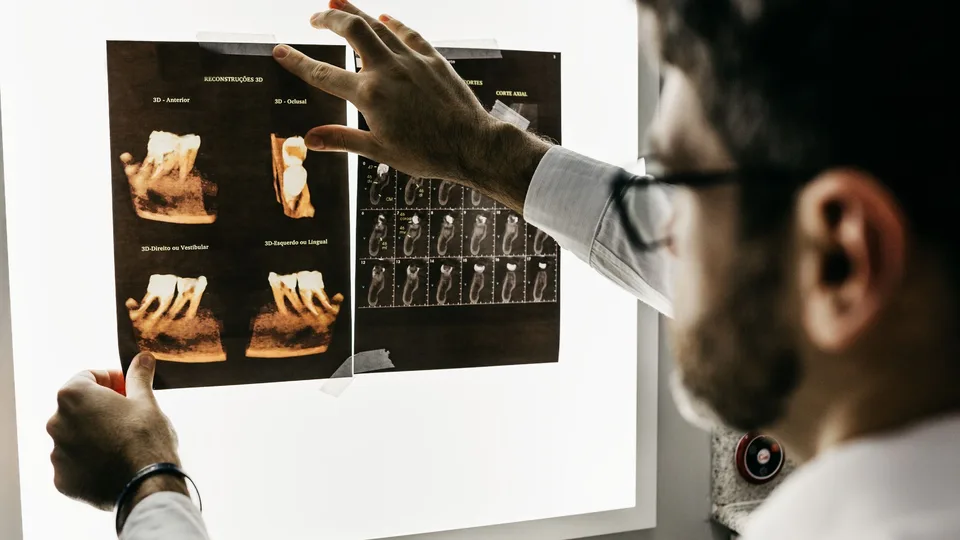
At the periodontal consultation (300 lei), the dentist uses a fine probe to measure the depth of the pockets between gum and tooth at six points on each tooth, checks for loose teeth and gum recession, and recommends the X-rays needed to see the bone level. All the measurements are recorded in a periodontal chart, the map we start from and against which we compare progress after treatment.
Laser treatment, step by step
- Professional cleaning. We remove tartar above the gumline with ultrasound, and tartar below the gumline, where ultrasound can't reach, with the laser.
- Laser curettage. On each affected tooth, the laser cleans out the pocket, removes the inflamed tissue and destroys the bacteria. It is done without a scalpel, with minimal bleeding and usually without stitches. It costs 185 lei per tooth.
- Regeneration. In advanced cases we can use regenerative proteins (Straumann Emdogain, 1,500 lei), which help the tissues rebuild, and we can cover areas where the gum has receded.
- Stabilising loose teeth. Loose teeth can be splinted together with a glass fibre strip bonded to their tongue side (700 lei per tooth).
Compared with conventional periodontal surgery, the laser means less pain, no stitches and healing in days rather than weeks. Usually 2 to 4 sessions are needed in the first month. Afterwards the swelling in the gums goes down, they bleed less and less, and the pockets get shallower.
What treatment costs
| Stage | Indicative price |
|---|---|
| Periodontal consultation with periodontal chart | 300 lei |
| Laser scaling, per tooth | 200 lei |
| Laser periodontal curettage, per tooth | 185 lei |
| Periodontal regeneration with Emdogain | 1,500 lei |
| Splinting of loose teeth, per tooth | 700 lei |
The total cost depends on how many teeth are affected and how deep the pockets are. After the periodontal chart, you receive a written plan with each stage and its price.
Gum disease in young people and in pregnancy
Gum disease isn't just a problem of old age. Some young people develop an aggressive form that destroys bone quickly, even when their hygiene seems good; the warning signs are front teeth that start to drift apart or a tooth that becomes loose before the age of 35. In pregnancy, hormonal changes make the gums more sensitive, and gingivitis is very common. A professional cleaning in the second trimester and careful brushing keep it under control and also protect the pregnancy.
Bad breath
In many cases, bad breath that mouthwash doesn't get rid of comes from the pockets under the gums, where bacteria produce sulphur compounds. Mouthwash masks it for a few hours, but it comes back. Treating the gums deals with the cause, and the smell usually disappears within a few weeks.
What you can do at home
- brush gently twice a day with a soft toothbrush, using strokes from the gum towards the tooth;
- clean between your teeth every day with interdental brushes of the right size (we'll show you which);
- use the mouthwash your dentist recommends, only for as long as advised;
- stop smoking, which masks bleeding and makes the disease harder to treat;
- keep diabetes under control, if you have it.
Follow-up after treatment
Periodontitis can't be cured once and for all, but it can be stopped and kept under control for decades. The key is regular check-ups and professional cleanings every 3 or 6 months, when we measure the pockets again and clean the areas where plaque has built up again. Patients who stick to this routine usually keep their teeth.
Frequently asked questions
Can gum disease be stopped?
Yes. With treatment and regular check-ups, the disease stabilises and the teeth can be kept for many years. Lost bone doesn't fully grow back, which is why it matters to start early.
Does the treatment hurt?
Laser curettage is much more comfortable than the conventional kind. For deep pockets we use local anaesthetic.
Can I have implants if I have gum disease?
Yes, once the disease has been stabilised. With untreated gums, the risk of inflammation around the implant (peri-implantitis) is high.
How often do I need check-ups?
In the first year, usually every 3 months. If things stay stable, check-ups can be spaced out to every 6 months.