When to bring your child for the first time, what happens at the get-to-know visit, how to talk about the dentist at home and which prevention really works for baby teeth.
When to bring your child for the first time
The first check-up is best at around the age of 2 or 3, when your child has most of their baby teeth, or earlier if you notice white or brown spots or holes in the teeth. An early visit has a big advantage: your child gets to know the clinic on a day when nothing hurts. A child's first meeting with the dentist should never be an emergency with toothache, because that is when a fear sets in that can last for many years.
What happens at the get-to-know visit
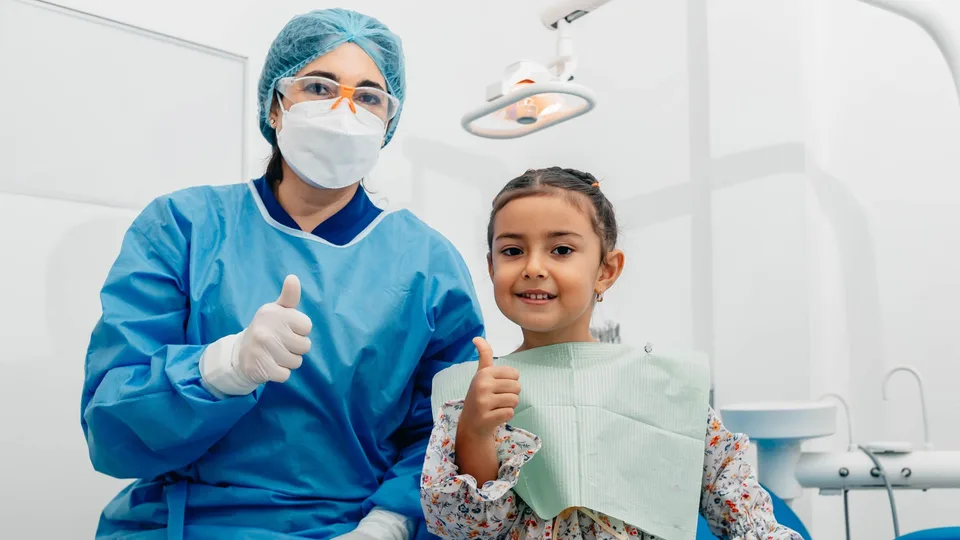
The first visit is not for treatment but for getting to know each other. Your child climbs into the chair on their own, makes it go up and down, looks in the mirror, touches the instruments and counts their teeth with the dentist. If they feel at ease, we polish their teeth with a little spinning brush, so they can see there is nothing to be scared of. You stay by their side the whole time. The dentist looks at the teeth, gums and bite and tells you if there is anything to keep an eye on. The first get-to-know visit is free and includes no unpleasant procedures.
If your child cries at the first visit and doesn't want to open their mouth, we don't force it. We stop, stay friends and try again in a few days. A visit with no treatment but a happy memory is worth more than a filling done in tears.
How to talk about the dentist at home
- Don't use the dentist as a threat (“if you don't brush your teeth, I'll take you to the dentist”). Your child will come to associate the dental clinic with punishment.
- Don't promise that “it won't hurt”: what your child remembers is the word “hurt”. Just say that the dentist will count their teeth and clean them.
- Don't talk about your own bad experiences in front of them. Children pick up their parents' fears faster than we think.
- Play “dentists” at home: count a doll's teeth, then your child's, with a little mirror.
- A few days before, read a book or watch a cartoon together about a visit to the dentist.
- Book the visit for the morning, when your child is rested and has eaten, not after a long day at nursery.
Why the laser changes everything for children
Most children aren't afraid of pain so much as of the noise and vibration of the drill, and of the injection. The dental laser involves none of these. A cavity in a baby tooth is usually treated in 15 to 20 minutes, most often without anaesthetic, and your child isn't left with the memory of an unpleasant experience. For a child who has already had a difficult visit somewhere else, this is the most convincing argument of all.
Yes, baby teeth do need treatment
Many parents ask why they should treat a tooth that will fall out anyway. The answer: baby teeth hold the space for the permanent teeth and guide them as they come through, and some stay in the mouth until the age of 11 or 12. An untreated cavity reaches the nerve, hurts, can lead to an abscess and can damage the permanent tooth forming underneath. A baby tooth removed too early lets the neighbouring teeth tilt into the gap, and the permanent tooth no longer has room to come through straight.
We treat cavities in baby teeth with the laser, carry out root canal treatment on baby teeth when the nerve is affected (250 lei per session) and extract loose teeth that won't fall out on their own or that are stopping the permanent teeth from coming through.
Prevention that really works
- Brushing done by a parent twice a day until the age of 7 or 8, when children have the dexterity to brush properly on their own. Use a fluoride toothpaste suitable for their age: an amount the size of a grain of rice up to the age of 3, the size of a pea after that.
- No bottle of milk or juice at bedtime, and as few sweet snacks between meals as possible. What matters is how many times a day they eat something sweet, not just how much.
- Fissure sealing of the permanent molars as soon as they come through (the first ones appear at around the age of 6, behind the baby teeth, and many parents mistake them for baby teeth). Sealing closes off the deep grooves where plaque collects: 200 lei per tooth, or 350 lei with the laser. On baby teeth, 200 lei, or 200 lei with the laser.
- Professional fluoride treatment, which strengthens the enamel, recommended by the dentist according to your child's risk of decay.
- A check-up every 6 months, with a children's professional cleaning (300 lei), even if everything seems fine. A small cavity caught in time means a few minutes in the chair, not a root canal treatment.
What we keep an eye on as your child grows
At 6 or 7 we recommend the first orthodontic check-up. Many problems with the way the jaws develop can be corrected simply while the child is still growing, with removable appliances or orthodontic trainers, far more easily than in adults. We also watch for habits that affect development: thumb-sucking, using a dummy after the age of 3, mouth breathing and pushing the tongue between the teeth. Our orthodontist, Dr. Cristina Împărățel, works together with the dentist who treats your child's teeth, so there is one single plan.
If a tooth gets knocked
Falls are common in children. If a permanent tooth has been knocked right out, hold it by the crown, not the root, don't rub it, put it in a glass of milk and come in immediately: the chances of the tooth being put back and taking hold again are highest within the first hour. A baby tooth that has been knocked out is not put back, but your child should still be seen by the dentist, because the blow can damage the permanent tooth underneath.
Frequently asked questions
My child cries and won't open their mouth. What do we do?
We don't force anything. The visit ends without treatment and we try again in a few days. For very young children or children with special needs, we discuss individual options.
Can I stay with my child in the treatment room?
Yes. At the first visits the parent stays beside the child. As they gain confidence, many children prefer to climb into the chair on their own, while the parent stays in the room.
At what age should my child first come?
At around 2 or 3, or earlier if you see spots or holes in the teeth. The first visit is a get-to-know visit and is free of charge.
Does laser treatment for children need anaesthetic?
Most of the time, no. The laser makes no noise and doesn't vibrate, and small cavities are treated without an injection.