Not every wisdom tooth has to come out. The signs that mean it should, how laser-assisted extraction works, what it costs and what to do in the first days afterwards.
Why wisdom teeth cause problems
Wisdom teeth are the last teeth to come through, usually between the ages of 17 and 25. Often there is no longer enough room for them in the jaw. They then stay stuck in the bone (impacted), only partly come through or grow in at an angle, pushing against the tooth in front of them. Over a partly erupted wisdom tooth there is a flap of gum where food gets trapped; this is where an infection called pericoronitis often develops, with pain, swelling, a bad taste and difficulty opening the mouth.
When a wisdom tooth should come out
- repeated infections of the gum around it;
- decay in the wisdom tooth or in the tooth in front of it that can't be treated because of where it sits;
- a cyst around the crown of an impacted tooth, visible on an X-ray;
- pressure on the teeth in front, before or after orthodontic treatment;
- recurring pain in the area with no other cause;
- a wisdom tooth with no opposing tooth that “drops down” and hits the gum of the opposite jaw.
A healthy, fully erupted wisdom tooth that you can brush properly and that has a tooth to meet when you chew can stay where it is. The decision is based on an examination and an X-ray, not taken “as a precaution, because it'll cause trouble anyway”.
Before the procedure
Tell us what medicines you take, especially anticoagulants or antiplatelet drugs such as a daily aspirin, and whether you have any chronic conditions or allergies or are pregnant. Don't stop a treatment prescribed by another doctor on your own: if necessary, we agree with your doctor on what to do in the days before the extraction. Eat normally before your appointment, because after the procedure you won't be able to eat for a few hours, until the anaesthetic wears off.
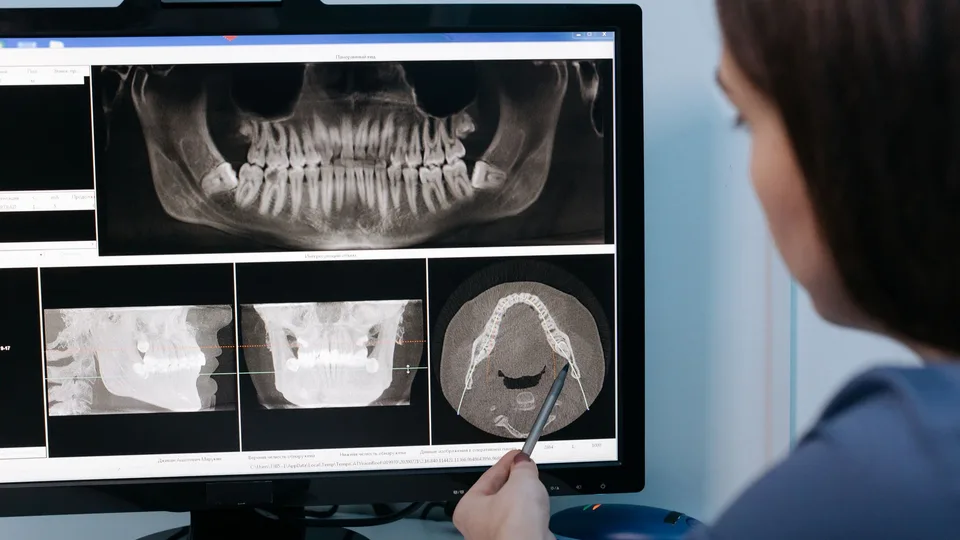
For impacted wisdom teeth we need a panoramic X-ray. It shows the position of the tooth, the shape of the roots and how far they are from the mandibular nerve and the maxillary sinus. When the roots are very close to the nerve, the dentist may ask for a CBCT scan, to know exactly how to approach the tooth and how much bone can be preserved. That way we avoid surprises during the procedure.
How the extraction is done
The procedure is done under local anaesthetic, so it doesn't hurt; you only feel pressure. For an erupted wisdom tooth, the extraction usually takes 15 to 20 minutes. For an impacted one, the gum and, if necessary, a small amount of bone are opened to reach the tooth, which is sometimes removed in pieces. The whole thing takes 30 to 45 minutes.
At Light Dental Clinic we use the Er:YAG laser to open the gum and bone and to sterilise the socket after the extraction. The cut is precise, small blood vessels seal on the spot and the area stays sterile. The result is less bleeding, less swelling and faster healing. Stitches are rarely needed.
What it costs
| Type of case | Price |
|---|---|
| Erupted wisdom tooth | 650 lei |
| Partially impacted wisdom tooth | 900 lei |
| Fully impacted wisdom tooth | 1,200 lei |
| Laser sterilisation after extraction | 150 lei |
The price includes the anaesthetic. The level of difficulty is assessed after the examination and X-ray, and we tell you the price before the procedure.
The first days after the extraction
- Keep biting on the gauze pad for 30 minutes. Don't rinse your mouth on the first day: the blood clot in the socket must stay in place, because it protects the bone and the new tissue forms from it.
- No smoking, alcohol, hot drinks or straws for at least 48 hours. Suction and smoke can dislodge the clot.
- Eat soft food, cold or lukewarm, on the first day, then gradually go back to your usual diet. Chew on the opposite side.
- Hold ice against your cheek, 15 minutes at a time with breaks, during the first few hours. Sleep with your head slightly raised.
- Take the recommended anti-inflammatory before the anaesthetic wears off, not once it starts to hurt. Take an antibiotic only if the dentist has prescribed one.
- From the second day, brush your teeth as usual, gently around the treated area, and rinse lightly with the mouthwash we recommend.
Thanks to the laser, there is much less swelling than after conventional surgery, and most patients are back to their usual routine within one or two days. At the follow-up visit, laser biostimulation speeds up healing.
A wisdom tooth is not replaced with anything: it is the last tooth in the arch, its absence doesn't show and it doesn't affect chewing. The bone in the socket fills in completely within a few months.
When to call your dentist
It is normal for the area to be tender for a few days and for the pain to ease from one day to the next. Call us if the pain gets worse after the third day instead of better, or if you have a fever, bleeding that doesn't stop after 30 minutes of pressure with a gauze pad, a persistent bad taste or swelling that keeps growing. It could be dry socket, an inflammation of the socket after the clot has been lost, which is easy to treat if you come in quickly.
The best time for an extraction
If your dentist recommends removing a wisdom tooth, the ideal time is before the age of 25, when the roots are not yet fully formed and the bone is more elastic: the extraction is simpler and healing is faster. Avoid times when you have exams or important events in the days that follow and, if possible, don't schedule the extraction during an acute infection; we treat the infection first, then remove the tooth.
Frequently asked questions
Are all wisdom teeth removed at the same time?
We usually remove one, or the two on the same side, so you can chew on the other side. The others follow two or three weeks later.
How long before I can eat normally?
On the first day, soft and cold food. From the second or third day you can eat almost normally, avoiding the extraction site.
Is removing an impacted wisdom tooth dangerous?
It's a routine procedure. The X-ray shows how the tooth sits in relation to the nerve and the sinus, and the laser reduces bleeding and the risk of infection.
Can I go to work the next day?
Most patients can. After removal of a fully impacted wisdom tooth, we recommend a day of rest.