What an implant is, why a missing tooth is worth replacing, the stages of treatment, what a complete implant really costs in Bucharest and how you recover after the procedure.
What is a dental implant?
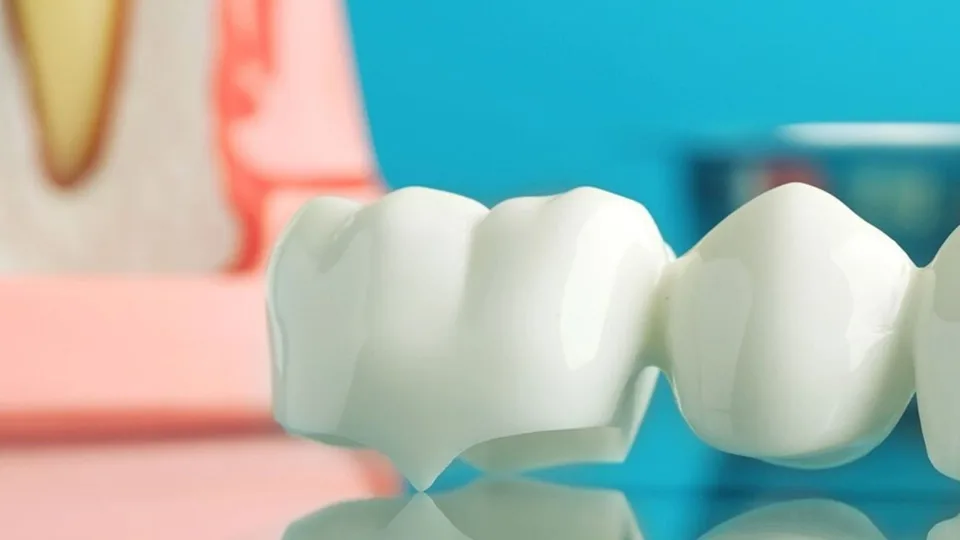
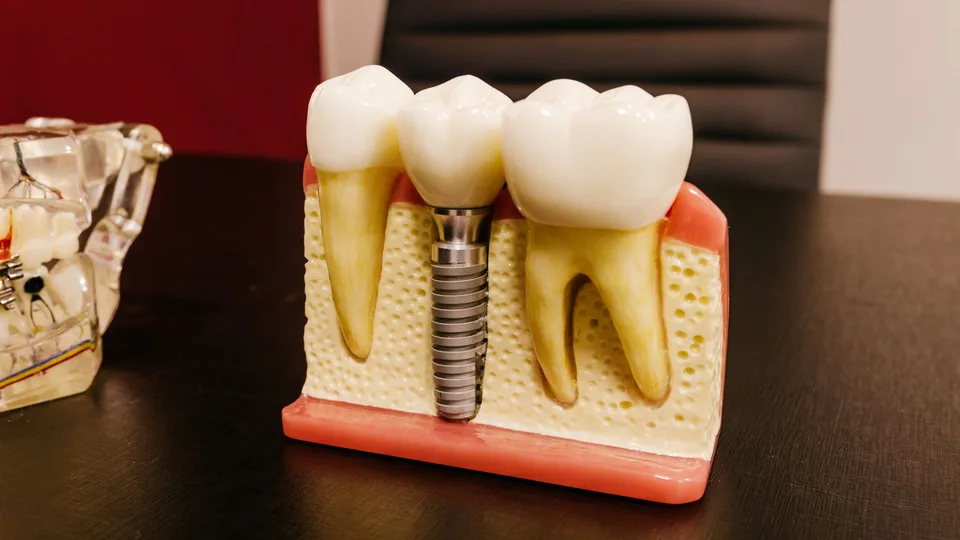
A dental implant is a small titanium screw, 3 to 5 mm in diameter, placed in the jawbone where the root of a lost tooth used to be. Over a few months the implant becomes biologically anchored in the bone, as a direct, stable bond forms between its surface and the surrounding bone tissue: a process called osseointegration. The bone heals around the implant and stabilises it, and only then can the crown be attached: an abutment is screwed onto the implant, and a ceramic or zirconia crown is fixed onto the abutment. The result looks and works like a natural tooth: you chew normally, speak normally and can't feel the difference.
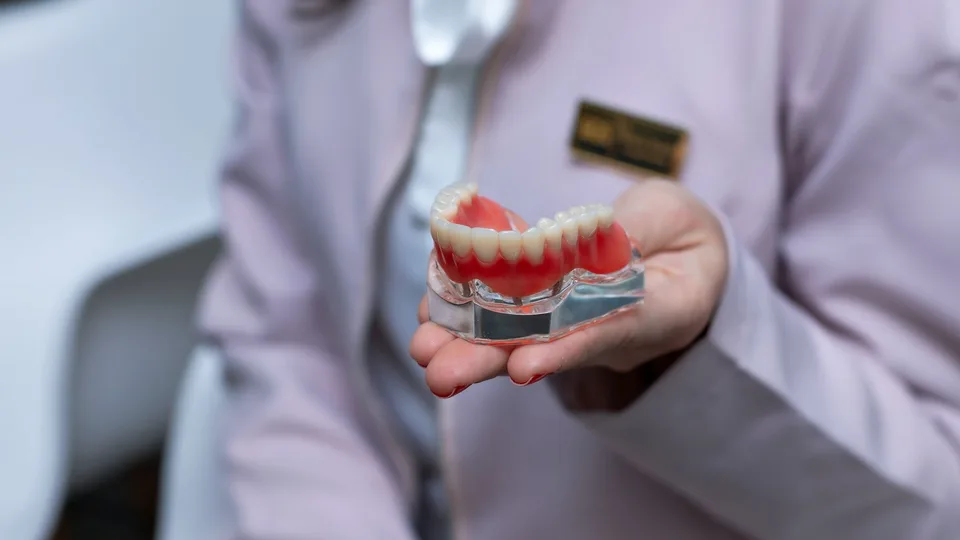
Unlike a conventional bridge, an implant doesn't rely on the neighbouring teeth. For a bridge, the two teeth on either side of the gap have to be filed down and turned into supports, even if they are perfectly healthy. Unlike a removable denture, an implant doesn't move, doesn't come out at night and doesn't cover the roof of your mouth.
Why you shouldn't leave a gap
Many patients put off replacing a back tooth because “it doesn't show”. The problem is that when the tooth goes, so does the stimulation the bone gets from chewing. In the first year after an extraction, the bone in that area shrinks noticeably and the neighbouring teeth start to tilt into the gap. The tooth in the opposite jaw, which no longer has a partner to bite against, slowly drifts towards the gap. Within a few years your bite changes, spaces open up between the teeth where food gets trapped, and your jaw joint may start to hurt.
The sooner the implant is placed after the extraction, the better the bone and the simpler the treatment. In many cases the implant can even be placed on the same day the tooth is removed, as long as there are no contraindications.
The treatment, step by step
- Consultation and plan. The dentist examines the area, checks the health of your gums and neighbouring teeth, and decides which X-rays or scans are needed (usually a panoramic X-ray or a CT scan). You receive a written plan with the full price: implant, abutment, crown and, if needed, bone grafting.
- Placing the implant. It takes 30 to 60 minutes for one implant and is done under local anaesthetic, so it doesn't hurt. At Light Dental Clinic the procedure is assisted by the Er:YAG laser: the gum is opened without a scalpel, bleeding is minimal and the area is sterilised as we work.
- Healing into the bone. This is followed by an average of 3 to 6 months of osseointegration, depending on the implant site, the quality of the bone and the individual patient. In the meantime you carry on with life as normal. On request we fit a temporary restoration, so you are never left without a tooth.
- The permanent crown. We take an impression, do a try-in and then fix the crown in place. This usually takes two visits, 7 to 10 days apart.
How much does a dental implant cost in Bucharest?
The price of a complete implant has three main components. At Light Dental Clinic, placing an implant costs 2,250 lei for systems made in Israel or Korea and 3,400 lei for premium implants made in Germany, Switzerland or Italy. The abutment costs 600 lei (1,100 lei for the zirconia version), and an implant crown starts at 1,450 lei, depending on the material.
| Component | Indicative price |
|---|---|
| Implant placement (Israel, Korea) | 2,250 lei |
| Implant placement (Germany, Switzerland, Italy) | 3,400 lei |
| Implant abutment | 600 lei |
| Implant crown | from 1,450 lei |
| Internal / external sinus lift, if needed | 1,500 / 2,700 lei |
So a complete implant, with abutment and crown, usually costs between 4,300 and 5,750 lei. The exact price depends on the implant system you choose, the crown material and how much bone you have. You receive it in writing after the consultation, before you make any decision.
Does it hurt? What recovery looks like
The procedure doesn't hurt, thanks to the local anaesthetic. Once the anaesthetic wears off, the area may be tender for a day or two, and an ordinary anti-inflammatory painkiller is usually enough. Laser assistance reduces inflammation and swelling, so most patients are back at their desks the next day.
- for the first 2 or 3 days, eat soft food that isn't too hot, chew on the other side and avoid dairy on the first day;
- avoid smoking for at least a week, as it slows healing and increases the risk of the implant failing;
- brush your teeth as usual, gently around the treated area, and use the mouthwash we recommend;
- avoid strenuous exercise for the first few days.
How long does an implant last?
The implant itself is very durable. The crown can wear and is replaced after 10 to 15 years on average. What matters most is good hygiene: brushing properly twice a day, cleaning between your teeth with interdental brushes or a water flosser, and a professional cleaning every 6 months, when we also check the gum around the implant. If inflammation develops around the implant (peri-implantitis), we treat it with the laser, which is considered the most effective method today.
Who can have an implant?
Almost any adult whose bone has healed after the extraction. Age is not a barrier: we also place implants for patients over 70. More care is needed with uncontrolled diabetes, osteoporosis treatment with certain medicines, radiotherapy to the head area and heavy smoking. We discuss these openly at the consultation and choose the safest option for you.
Frequently asked questions
Can I have an implant straight after an extraction?
Often, yes, if there is no infection and there is enough bone. This is called an immediate implant, and it shortens treatment by a few months.
What if I don't have enough bone?
We do a bone graft or a sinus lift, often during the same procedure as the implant. The price and timing are included in your plan.
Does it feel different from a natural tooth?
No. Once healed, an implant with its crown feels like a natural tooth when you chew and when you speak.
Can an implant be rejected?
Titanium does not cause adverse reactions or allergies. Rarely, an implant fails to integrate with the bone, usually in smokers or when there is an infection; in that case it is replaced once the area has healed.